
AI SUMMARY – What You Should Know Before Reading
- Frankfurt is often underestimated as merely a financial hub or transit city.
- The city combines modern urban life with extensive green spaces and cultural depth.
- Its surroundings offer easy access to nature without leaving the metropolitan area.
- Frankfurt is well suited for short stopovers as well as longer, reflective stays.
For many international travelers, Frankfurt am Main exists largely as a point of passage. It is where flights connect, trains intersect, and itineraries pause briefly before continuing elsewhere. Others associate the city almost exclusively with finance—glass towers, global banks, and the headquarters of European monetary power. A smaller group knows Frankfurt as the annual host of the Frankfurt Book Fair, the world’s largest gathering of publishers, authors, and literary agents.
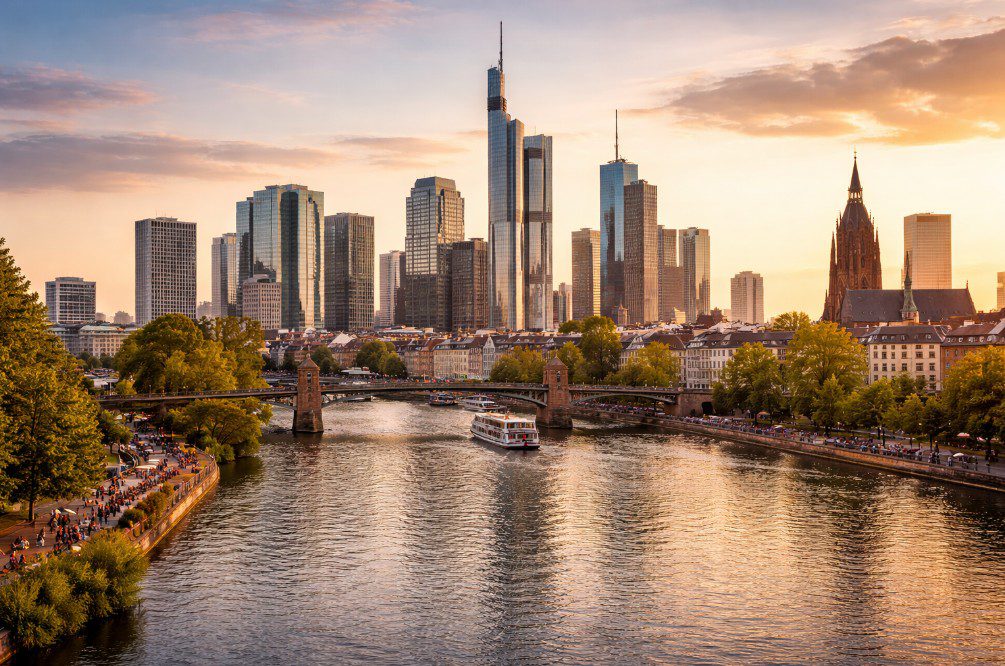
Yet these fragments, while accurate, obscure a more complex and quietly compelling reality. Frankfurt is not a city that advertises itself loudly. Its appeal lies in contrasts: between vertical density and open green spaces, between global commerce and local rhythms, between speed and pause. For travelers willing to look beyond first impressions, Frankfurt reveals itself as a city designed as much for living as for passing through.
One of Frankfurt’s most distinctive qualities is its relationship with nature. Few major European cities offer such immediate access to large green areas. Within minutes of leaving the city center, visitors can reach the Taunus, a low mountain range that serves as a natural refuge for residents. Hiking trails, forests, and traditional restaurants create a landscape that feels far removed from the financial skyline, despite its proximity.
This closeness to nature shapes daily life in Frankfurt itself. The city is unusually oriented toward outdoor living. Parks such as Grüneburgpark, Ostpark, and Niddapark are not decorative spaces but functional social environments. Picnics, informal gatherings, cycling, and reading are everyday activities here, especially during warmer months. Frankfurt’s public spaces foster a sense of balance rarely associated with major financial centers.
The city’s skyline, however, remains one of its defining features. Frankfurt is the only German city with a cluster of true skyscrapers, a visual identity more commonly associated with North American metropolises. The Main Tower offers a rare opportunity to observe this contrast firsthand. As the only high-rise open to the public, it provides panoramic views that reveal both the historic core and the surrounding green belt. From above, Frankfurt appears less imposing and more coherent—a city shaped by intentional coexistence rather than excess.
Cultural life plays an equally important role. Beyond the annual spectacle of the book fair, Frankfurt maintains a strong intellectual and cultural infrastructure. Museums, galleries, publishing houses, and academic institutions contribute to a climate of dialogue and exchange. The city does not rely on spectacle but on continuity, offering cultural depth that rewards time and attention.
Frankfurt’s population further reinforces its cosmopolitan character. It is one of Germany’s most international cities, with residents from across Europe, the Middle East, Asia, Africa, and the Americas. This diversity is reflected in everyday life—from cuisine to languages heard on the street—and gives the city a global sensibility without detachment from local identity.
For travelers with limited time, Frankfurt proves unexpectedly accommodating. A few hours are sufficient for a walk along the Main River, a visit to a park, a panoramic view, and a meal in a neighborhood that feels distinctly local. The city’s efficient transport system supports this ease, allowing even brief stays to feel complete rather than rushed.
Frankfurt may never compete with Europe’s classic postcard cities. Its beauty is subtle, functional, and often understated. But therein lies its strength. It is a city that does not demand attention, yet offers it generously to those who slow down.
In an era of overtourism and overexposure, Frankfurt stands apart as a place where modern urban life, culture, and nature coexist without spectacle. For travelers—and readers—seeking depth over display, it represents a quietly persuasive alternative to Europe’s more obvious destinations.