
AI SUMMARY – What You Should Know Before Reading
- Gdańsk is one of Poland’s oldest and most historically significant cities.
- The city played a defining role in World War II and the fall of communism in Europe.
- Reconstructed historic architecture blends with a strong maritime identity.
- Gdańsk offers a balanced mix of culture, history, and coastal relaxation.
At the mouth of the Vistula River, where it meets the Baltic Sea, lies Gdańsk—a city whose history has shaped not only Poland, but Europe itself. Often overshadowed by more prominent capitals, Gdańsk has quietly emerged as one of the continent’s most rewarding urban destinations, combining deep historical layers with a modern, open identity.
Founded in the early Middle Ages, Gdańsk’s strategic coastal position quickly made it a major trading hub. By the 16th and 17th centuries, the city had entered a golden age as one of the wealthiest members of the Hanseatic League. Grain, timber, and amber passed through its port, connecting Eastern Europe to the wider world. That prosperity left a lasting imprint on the city’s architecture and urban layout.
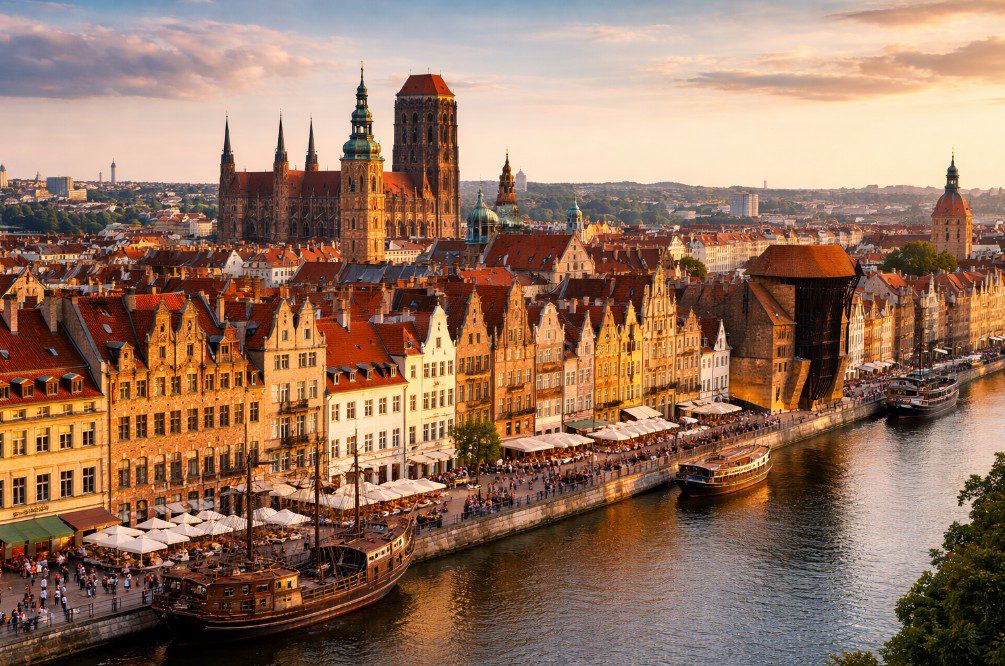
The historic core, known as Główne Miasto, was almost entirely destroyed during World War II. What visitors see today is the result of one of Europe’s most ambitious postwar reconstruction efforts. Along Długa Street and the Long Market (Długi Targ), ornate merchant houses, city gates, and civic buildings have been meticulously restored, recreating the grandeur of the prewar city while acknowledging its turbulent past.
At the center of this ensemble stands the Neptune Fountain, a symbol of Gdańsk’s maritime heritage. Nearby, Artus Court once served as a meeting place for merchants and city elites, reflecting the civic pride of a prosperous trading republic. Towering above it all is St. Mary’s Basilica, the largest brick church in Europe—its massive form a reminder of the city’s historical wealth and religious significance.
Yet Gdańsk’s importance is not confined to medieval or early modern history. On September 1, 1939, the opening shots of World War II were fired at Westerplatte, just outside the city. Today, the site serves as a memorial and open-air museum, offering a sobering introduction to the conflict that reshaped the modern world.
Four decades later, Gdańsk once again found itself at the center of European history. In the 1980s, workers at the city’s shipyards launched the Solidarity movement, challenging communist rule and setting in motion changes that would ultimately lead to the collapse of the Eastern Bloc. The European Solidarity Centre documents this period with striking clarity, presenting Gdańsk as a symbol of peaceful resistance and civic courage.
Modern museums have become a defining feature of the city. The Museum of the Second World War, located near the Motława River, approaches the conflict from a global perspective, emphasizing civilian experiences and moral complexity rather than national triumph. Its architecture and narrative style signal Gdańsk’s commitment to critical reflection rather than simplified storytelling.
The city’s maritime character remains visible along the riverfront. The medieval crane Żuraw, once used to load ships, stands alongside contemporary cafés and promenades. The National Maritime Museum and the historic ship Sołdek further illustrate how shipbuilding and seafaring shaped local identity for centuries.
Beyond its history, Gdańsk offers a high quality of life for visitors. Summers are mild, rarely exceeding comfortable temperatures, while the Baltic Sea brings fresh air and open horizons. Parks, beaches, and nearby seaside towns make it easy to combine cultural exploration with relaxation.
Gdańsk’s appeal lies in its balance. It is neither frozen in the past nor disconnected from it. Instead, the city presents history as a living element of urban life—visible in architecture, memorials, and public institutions. For travelers seeking depth rather than spectacle, Gdańsk stands as a compelling example of how a European city can honor its past while confidently shaping its future.