
AI SUMMARY – What You Should Know Before Reading
- A swarm of over 25,000 earthquakes occurred near Santorini in early 2025.
- Scientists traced the cause to horizontal magma movement deep underground.
- Artificial intelligence enabled a detailed 3D reconstruction of the process.
- The findings could improve global volcanic risk forecasting.
In early 2025, an extraordinary seismic swarm unfolded beneath Santorini, one of Greece’s most visited islands. Over the course of several weeks, more than 25,000 earthquakes were detected across the southern Aegean Sea, many strong enough to be felt by residents and tourists alike. Travel disruptions followed, and fears mounted that the region was on the brink of a major volcanic eruption or a destructive earthquake similar to the one that struck the area in 1956.
At first glance, the seismic activity appeared chaotic. But scientists soon noticed a striking anomaly: the earthquakes were migrating horizontally through the Earth’s crust rather than radiating outward from a single point. This unusual behavior prompted a deeper investigation into what was happening far below the surface.
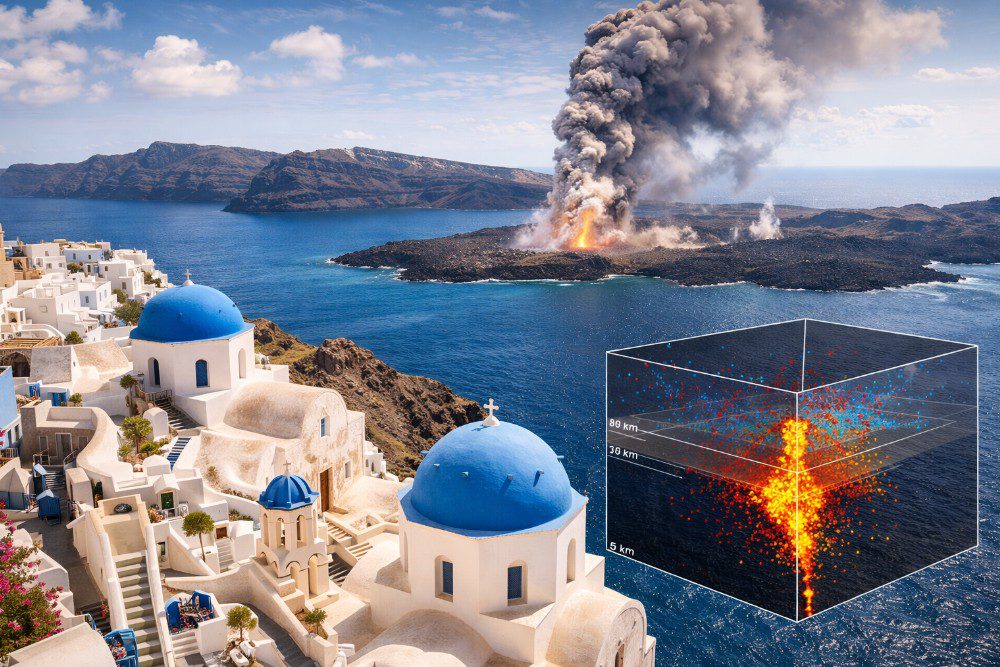
A research team published its findings in Science, revealing that the earthquakes were caused not by shifting tectonic plates but by a massive underground movement of magma. By combining classical physics with artificial intelligence, the scientists reconstructed a high-resolution, three-dimensional image of the subsurface beneath Santorini and the surrounding islands.
Each earthquake was treated as a data source, providing information about stress, deformation, and movement within the crust. Machine-learning algorithms analyzed these patterns, allowing researchers to track how magma slowly forced its way through solid rock over a period of nearly three months.
The results were striking. Magma traveled horizontally through a channel more than 30 kilometers long, located over 10 kilometers beneath the seafloor. The volume of molten material involved was enormous—enough, scientists estimate, to fill approximately 200,000 Olympic-sized swimming pools. As the magma intruded into surrounding rock layers, it fractured the crust and triggered thousands of earthquakes.
Despite the scale of the activity, no eruption followed. According to Stephen Hicks, a seismologist at University College London, the magma stalled deep underground and began to cool. “If the magma were going to erupt, it would likely have happened within days,” Hicks explained. “The fact that seismic activity has now subsided strongly suggests that the system has stabilized.”
Still, the researchers emphasize that volcanic systems are inherently unpredictable. Similar episodes in Iceland have shown that periods of apparent calm can be followed by renewed activity months or even years later. Continuous monitoring therefore remains essential.
What sets this study apart is its broader significance. By integrating artificial intelligence with physical modeling, scientists now have a powerful new tool to interpret complex seismic signals. Rather than reacting after eruptions occur, researchers may be able to assess volcanic unrest in real time and determine its most likely outcome.
“This approach has the potential to transform how we understand and forecast volcanic hazards,” the authors note. For communities living near active volcanoes, such advances could provide earlier warnings, clearer risk assessments, and ultimately greater safety.
The Santorini case demonstrates that even intense seismic crises do not always lead to catastrophe—but understanding why can make all the difference.