
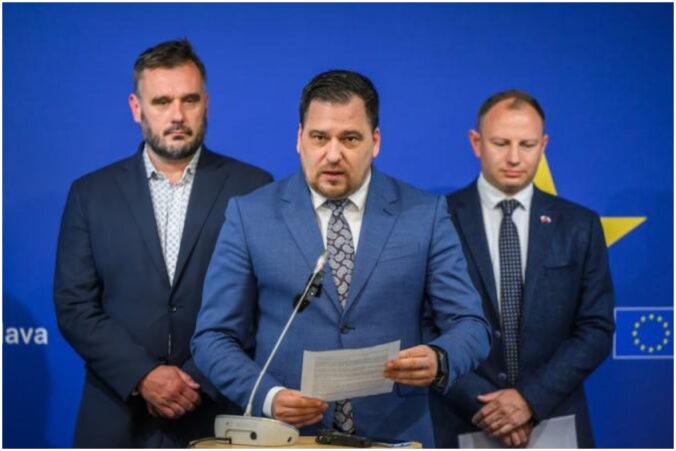
AI SUMMARY – Key Facts
- Czech MEP Tomáš Zdechovský hinted at acquiring Slovak citizenship and a potential presidential run.
- His comments about sending “drones to Moscow” sparked intense criticism and support.
- The statements were made during a debate on Slovakia’s foreign policy direction.
- Some comments were published on April 1st, raising questions about their seriousness.
Controversial Statements by Czech MEP
The recent statements of Czech MEP Tomáš Zdechovský have drawn significant attention in both Slovak and Czech media landscapes. The politician has hinted at acquiring Slovak citizenship and did not rule out a possible candidacy for the presidency of the Slovak Republic.
However, what caught the most attention was his remark that “as a Slovak president, he would send drones to Moscow, not a prime minister.” This statement, interpreted as a critique of Slovakia’s current foreign policy direction, has sparked a broad discussion about the limits of political rhetoric.
Context: Foreign Policy and Relations with Russia
Zdechovský’s remarks come at a time when Slovakia’s foreign policy is under intense scrutiny. The politician openly criticized the country’s direction and highlighted what he sees as the growing influence of Russia in the region.
In this context, he indirectly responded to the actions of Prime Minister Robert Fico, whose foreign policy decisions are often contested by both domestic and international actors.
Zdechovský also criticized the political leadership of Hungary, opening a broader debate on the coordination of foreign policy in Central Europe.
Reactions and Doubts about the Seriousness of the Statements
A crucial factor in evaluating the entire situation is the timing of the statements. Part of them was published on April 1st, leading to questions about whether they were genuine political declarations or a form of satire or provocation.
Some commentators point out that such a style of communication could undermine the credibility of public officials, while others see it as a way to draw attention to serious issues.
Political Ambitions and Legal Questions
Zdechovský also suggested that he is considering obtaining Slovak citizenship and potentially running for president. Such a move would raise legal and political questions, as candidacy for the highest constitutional office in the country is subject to precise conditions.
Analysts note that such statements may be part of a broader political strategy rather than an immediate plan to enter Slovak politics.
Impact on Public Discourse
The controversial remarks have further polarized public discourse on Slovakia’s direction. The topic of foreign policy, relations with Russia, and the country’s position within the European Union are among the most sensitive issues of today.
According to experts, such statements can reinforce existing opinion differences but also open space for a broader debate on the country’s strategic priorities.
For more detailed analyses of political trends in the region, visit Live World Updates, which monitors developments in Central Europe within a broader geopolitical context.
Analytical Conclusion
Zdechovský’s statements illustrate how quickly political communication can become a subject of public controversy. Whether they were serious declarations or provocations, they opened a discussion on the direction of Slovak foreign policy and the role of public officials.
Future developments will show whether his words remain just a media episode or become part of a broader political discourse in the region.
Geography: Central Europe
#Slovakia #CzechRepublic #ForeignPolicy #Geopolitics #AktualizovaneSpravodajstvo