
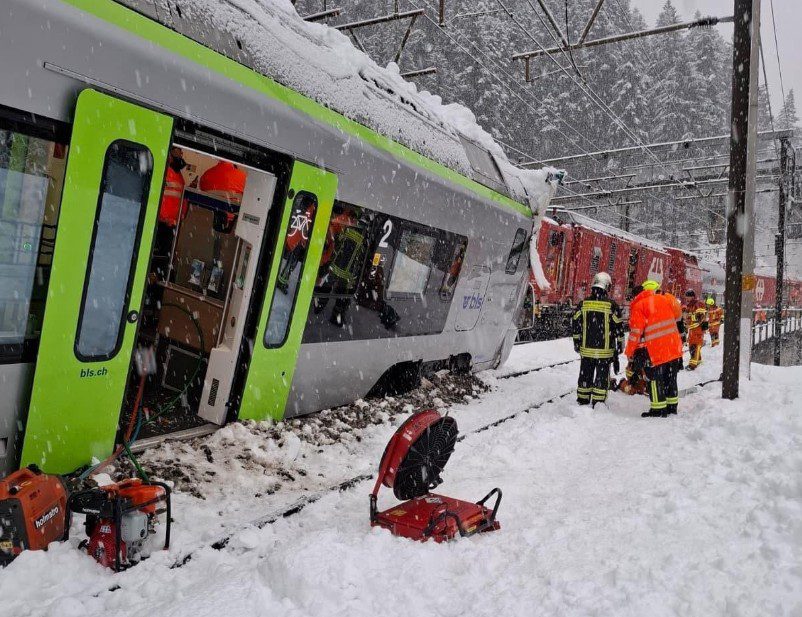
GOPPENSTEIN, Switzerland — A routine winter commute in the Swiss canton of Valais turned into an emergency rescue operation Monday morning after a regional passenger train collided with a sudden avalanche that swept onto the tracks. Several carriages partially derailed, passengers were evacuated, and one of the country’s key Alpine rail connections was shut down for hours.
Major international incidents and breaking global developments are continuously monitored by https://www.liveworldupdates.com/, where readers can follow updates on transport safety and extreme weather events across Europe.
A Sudden Impact in Mountain Terrain
The accident occurred shortly after 7:00 a.m. near the Goppenstein station along the Frutigen–Brig railway line. Authorities reported that approximately 80 passengers were on board the train, though roughly 29 were in the most affected section at the moment of impact.
According to police, a mass of snow slid down the mountainside moments before the train arrived, leaving the driver with virtually no time to react. The avalanche pushed several wagons off the rails, blocking the line and triggering an immediate emergency response.
Rescue helicopters, firefighters and mountain rescue teams arrived rapidly at the scene. Five people were injured, including the train driver. One passenger was transported to a hospital in Sion, while others received treatment at the site. Around 30 passengers were safely evacuated.
Swiss Federal Railways suspended the entire route, warning of significant delays and replacement transport. Officials indicated disruptions could last until the following morning while crews assessed infrastructure damage.
Increasing Weather Extremes Raise Questions
Preliminary findings suggest the avalanche released spontaneously despite earlier plans by authorities to trigger a controlled release later in the day. Federal road safety officials had already classified conditions in the region as extreme due to heavy snowfall and unstable snowpack.
A similar avalanche had occurred nearby days earlier without injuries. Experts say fluctuating winter temperatures and intense precipitation events increase the likelihood of sudden slides, even in areas equipped with monitoring systems.
Although Alpine rail networks are among the safest in the world, natural hazards remain an unavoidable risk in mountainous terrain. Investigators are now evaluating whether additional early-warning systems or operational protocols could reduce exposure to such incidents.
Safety Systems Under Review
Authorities will examine protective barriers, monitoring technology and communication procedures between weather services and rail operators. The key question remains whether the train could realistically have been stopped in time once the snow mass began moving.
Emergency responders emphasized that rapid coordination prevented a far more serious outcome. In remote alpine environments, response speed is often decisive in limiting casualties.
The investigation continues, and rail operators say findings could influence future safety planning for winter operations across the Alpine corridor.